Board members brainstorming with Funidata employees – what did we learn from the pilot?
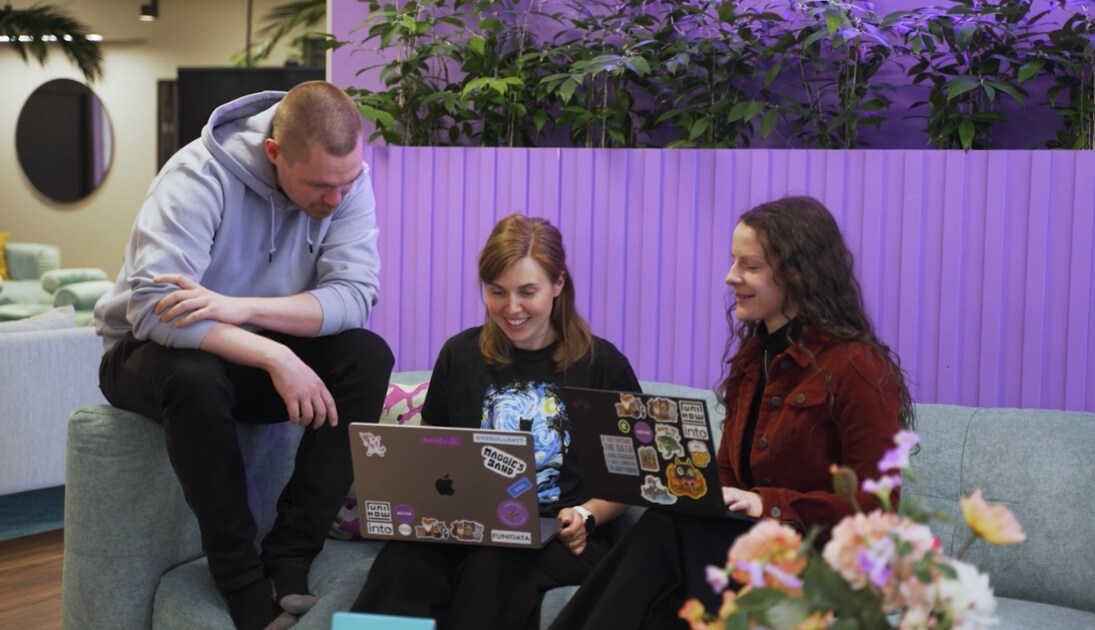
Funidata’s mentoring and sparring brought the board closer to everyday work. The pilot strengthened competence development and provided new perspectives on work.
This spring, we launched a pilot programme at Funidata for the first time, giving eight Funidata employees the opportunity to brainstorm on topics of their choice directly with members of our board. The initiative originated from a proposal by the board and was seen as a great opportunity to develop one’s own expertise. It was inspiring that board members willing to share their knowledge and experience with Funidata employees.
We already have an internal mentoring program in place, where Funidata employees support each other across team boundaries. The idea for the sparring sessions did not, therefore, come out of nowhere, but is a continuation of our existing practices for developing expertise at Funidata. Board-level sparring took this a step further by bringing in perspectives and experience from the board. What unites both approaches is a shared belief that learning emerges through dialogue, trust, and taking the time to reflect on relevant topics.
What motivated Funidata employees to take part in the sparring sessions?
At first, there was some uncertainty about whether there would be enough participants and how the model would work in practice. However, the level of interest exceeded expectations, with more employees volunteering than we were able to include this time.
Participants joined the sessions with enthusiasm and curiosity. Many felt that, alongside their day-to-day work, there is a need for space to think more strategically, reflect on their own ideas, and gain an external perspective. There was also a clear interest in getting to know the board members better and understanding their views and experiences. For many, the sessions provided an opportunity to explore a chosen topic in greater depth and receive support for their thinking.
The sessions were not approached without preparation. We took time to plan the pilot together and to consider in advance what expectations and themes participants would bring to the discussions. In practice, the sparring sessions followed a light and flexible model. Each pair arranged their meetings independently, with one to four sessions per pair. This allowed the process to be shaped by participants’ individual needs and made it possible to reflect on discussions and test ideas in practice between meetings.
Themes from everyday work brought the board closer to daily life
One of the most significant outcomes of the sessions was that the board became more closely connected to the everyday work of Funidata employees. Faces became familiar, a natural dialogue emerged, and the threshold for further discussions was lowered. For some, it was the first time they had the opportunity to engage in a direct, one-to-one conversation with a board member over a longer period.
Although more strategic topics were also discussed, the conversations remained grounded in practical realities. The themes stemmed from participants’ own work and everyday situations. Topics included collaboration between sales and marketing, change management and leadership, the development of customer work, and the specific characteristics of the higher education sector. The sessions helped build a deeper understanding of how the board views Funidata’s operations and development as a whole.
Experiences and examples added depth to the discussions
The board members’ willingness to share their own experiences and examples was particularly valuable. Discussions focused on what has worked, what has not, and why. This made the conversations concrete and helped participants see how similar challenges could be approached in their own work.
Many described the sessions as clarifying and reinforcing their own thinking. While not everyone gained entirely new insights, it was considered valuable that their observations and perspectives were validated externally. The sessions offered a mirror to the current situation and helped clarify the next steps within each participant’s own context.
The sessions also proved valuable for the board members. An open and trusting atmosphere enabled genuine dialogue, and the discussions provided a deeper understanding of Funidata’s day-to-day work, practical themes, and challenges.
What did we learn and what comes next?
At the end of the pilot, we held a joint wrap-up session to share experiences and reflect on what worked well and what could be improved. These insights were also shared more broadly with colleagues at a team-wide meeting.
Based on our experiences, the elements that worked particularly well included the relaxed and conversational format, content driven by participants’ own themes, and multiple sessions that allowed topics to be explored in greater depth between meetings. The pilot reinforced the view that there is a clear need for board-level expertise also in everyday work.
Next, we will build on the lessons learned and further develop the model by clarifying objectives, roles, and target groups. Together with our internal mentoring programme, board-level sparring forms a coherent and complementary whole. It is clear that continuing with different forms of sparring and mentoring is worthwhile.
Thank you to all Funidata employees and board members who participated for your openness, time, and willingness to share your expertise and learn together.
